
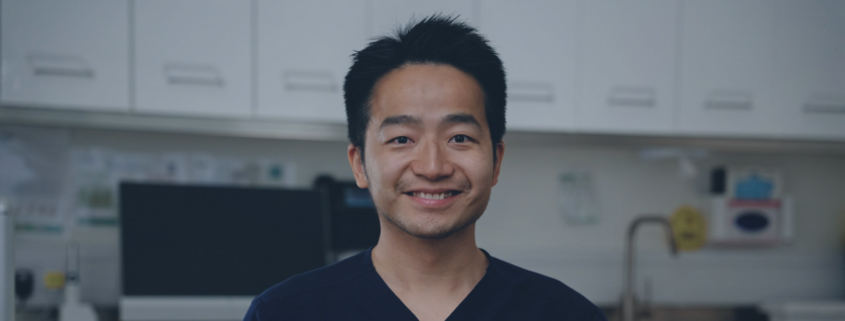
How we combine health, function and aesthetics in restorative dentistry – Denny (Chon Pei) Wang, Specialist Prosthodontist
By Denny (Chon Pei) Wang, Specialist Prosthodontist at Devonshire House Dental Practice
Denny (Chon Pei) Wang is a Specialist Prosthodontist at Devonshire House Dental Practice in Cambridge, with particular expertise in prosthodontics, complex restorative treatment, and aesthetic dentistry. His work includes treating tooth wear, restoring damaged teeth, replacing missing teeth, managing bite problems, and planning full-mouth restorations. Alongside his clinical work, Denny lectures at UCL and holds an Honorary Assistant Professor position at the University of Hong Kong.
Patients come to me because there’s something about their smile they want to change. That might be worn or damaged teeth, gaps, discolouration, or sometimes just a smile that no longer feels right for them.
Treatments like composite bonding, veneers, and crowns can all help – but in my experience, a truly successful result brings together three things:
- Health: We need healthy foundations
- Function: We need to understand how the teeth and bite work.
- Aesthetics: Then we can design a smile that looks right for that individual patient.
Whether you’re considering restoring your smile or interested in careers at Riverdale Healthcare, in this article I’ll explain how our approach at Devonshire House Dental brings those three elements together – from planning and trial smiles to choosing the right materials and using a combination of digital tools, traditional techniques, and close collaboration with our on-site laboratory.
Book your appointment with Devonshire House Dental.
Key takeaways
- Health comes first: cosmetic or restorative treatment needs to be built on healthy teeth and gums.
- Aesthetics should be individual: the shape, colour, and proportions of a smile should suit the patient, not follow a standard template.
- Function and appearance should be planned together: the bite needs to work properly as well as the smile looking right.
- Complex treatment should be carefully planned and trialled: patients should be able to see and refine the proposed result before final treatment where appropriate.
- Treatment choices should be based on the case, not the trend: materials and technology should be selected for what will work best for the individual patient.
Good cosmetic dentistry starts before the cosmetic treatment
It can be tempting to jump straight to how you want your finished smile to look. Before starting more complex restorative or cosmetic dentistry, however, we need to know that we have a healthy foundation.
That means looking at things like:
- Tooth decay
- Gum health
- Existing restorations
- Worn or damaged teeth
- Missing teeth
- How the upper and lower teeth meet
If there’s active decay or gum disease, for example, we need to address that first. Sometimes another treatment also makes sense before we begin the main restorative work. If someone would like a lighter smile, for example, whitening can help us establish the right base colour before choosing the final shade of composite or ceramic restorations.
The cosmetic result is important – but it needs to be built on healthy teeth and gums rather than used to cover problems underneath.
A smile should be designed for the individual
One of the parts of restorative dentistry I’m particularly interested in is smile design – I don’t believe in giving every patient the same shape or style of teeth. A smile needs to suit the individual person, not conform to some standardised ideal.
When I’m planning treatment, I look at the teeth alongside the patient’s face and smile frame. We can use photographs and digital scans to consider how the teeth relate to features like the eyes and nose, rather than looking at them in isolation.
Some people are looking for a subtle improvement. Others want a more significant change. The right result should also reflect the individual’s end goal rather than somebody else’s idea of the perfect smile.
Patients should be able to test the plan before committing to it
For more involved treatment, I like to spend time planning and trialling the result before we move on to the final restorations.
After taking photographs and scans, we can work with our dental laboratory to create a diagnostic wax-up – a model of the changes we are proposing.
From that, we can create a trial smile.
That allows the patient to see the proposed shape and proportions in their own mouth before committing to the finished treatment.
We can look at:
- Whether the teeth feel too long or too short
- How the smile sits within the face
- Whether the shape looks natural
- Whether anything needs adjusting
- How the bite feels
For some patients, one trial is enough. More complex restorative treatment may need further planning.
This stage is vital, turning smile design into a conversation. Instead of asking somebody to imagine the finished result, we can show them the direction we are taking and refine it together.
A smile has to work as well as it looks
Appearance is just one part of restorative dentistry. Some of the patients I treat have significant tooth wear caused by grinding, erosion, or other factors. Others have missing or damaged teeth, or problems with the way their upper and lower teeth meet.
In those situations, we need to understand the bite as well as the appearance.
If we rebuild worn teeth without considering why they became worn, or significantly change their shape without understanding how they meet, we risk overlooking an important part of the problem.
That’s why we assess function throughout the planning process.
The aim isn’t just to create a smile that looks good in a photograph. It should also feel comfortable, work properly, and be planned with long-term durability in mind.
Digital tools should support clinical judgement, not replace it
Digital dentistry is giving us much better ways to collect information and plan treatment. Scans and photography can help us understand the teeth in the context of the patient’s whole face. That allows smile design to become more personalised.
I don’t believe, however, that everything should become completely digitised just because the technology is available.
Traditionally, prosthodontic treatment has used physical models and devices called articulators to help assess how the upper and lower teeth meet and move.
Those methods still have value.
Patients get the best results from a hybrid approach: we use digital tools where they give us more information, while retaining traditional techniques where they help us assess function more accurately.
The important thing isn’t whether a tool is digital or physical. It’s whether we are using the right tools to understand their case fully before treatment begins.
The right material depends on the patient
Patients sometimes arrive having already decided that they want composite bonding, dental veneers, or crowns. There’s plenty of information about these treatments online, but in reality there is no single material that is automatically best for everybody.
Composite is a tooth-coloured material that can be used to rebuild and reshape teeth. It can often involve less alteration of the natural tooth and generally has a lower initial cost, but it usually requires more maintenance over time.
Ceramic restorations such as veneers and crowns can offer greater durability and very strong aesthetic results – but they generally cost more and, depending on the case, can require some natural tooth structure to be removed.
The question’s not as simple as “which treatment is best?”
The better question is “which treatment is right for this tooth, this patient, and what we are trying to achieve?”
A big part of my role is explaining the options – their advantages and their compromises – clearly so that patients can make an informed decision based on their wants and needs.
Close collaboration with our laboratory makes a real difference
Restorative dentistry is often a collaboration between the dentist and the technician who creates the restoration, so one of the advantages of carrying out complex restorative treatment at Devonshire House is having our dental laboratory on site.
For ceramic work, patients can attend the laboratory directly for shade matching, allowing the technician to see the teeth in person and tailor the restoration more closely.
Having the laboratory within the practice also makes it easier to discuss complex cases, check work, make adjustments, and maintain close quality control. If an existing restoration such as an implant bridge fractures, having the laboratory on site can make a much faster repair possible.
For me, that close relationship between patient, dentist, and technician is another part of making each treatment as considered and individual as possible.
Each treatment option is a tool
If you are considering a smile makeover or more complex restorative dentistry, I would encourage you to look beyond the name of the treatment. Composite bonding, veneers, crowns, bridges, and implants are all tools. What matters is how they’re used and why.
A good treatment plan should consider:
- The health of your teeth and gums
- Why your teeth are worn, damaged, or missing
- How your bite functions
- What you want your smile to look like
- The advantages and compromises of different treatments
- How much healthy tooth structure each option may affect
- What maintenance will be needed afterwards
- Whether you can preview or trial the proposed result
For me, restorative and cosmetic dentistry is not about creating the same smile for every patient. It’s about protecting what’s healthy, restoring what needs attention, and bringing health, function, and aesthetics together in a way that truly works for the patient.
Book an appointment with Devonshire House Dental
If you are considering restorative or cosmetic dentistry in Cambridge, speak to the team at Devonshire House Dental Practice about your options.